
What Is Bitcoin’s Total Addressable Market Thesis?
Ask a Bitcoin bull why the price could go dramatically higher from here, and the answer usually isn’t a chart pattern, it’s a comparison to something much bigger. The total addressable market thesis is that framework made explicit: size Bitcoin against the markets it could plausibly capture a share of.
How the TAM Model Actually Works
The approach compares Bitcoin’s current market capitalization against the size of a larger reference market, gold, the global money supply, or central bank reserve assets are the three most common benchmarks, then asks what Bitcoin’s price would need to be if it captured some percentage of that larger pool. VanEck’s version of the model specifically targets two addressable markets: Bitcoin as a global medium of exchange and Bitcoin as a central bank reserve asset.
The Actual Numbers Being Compared
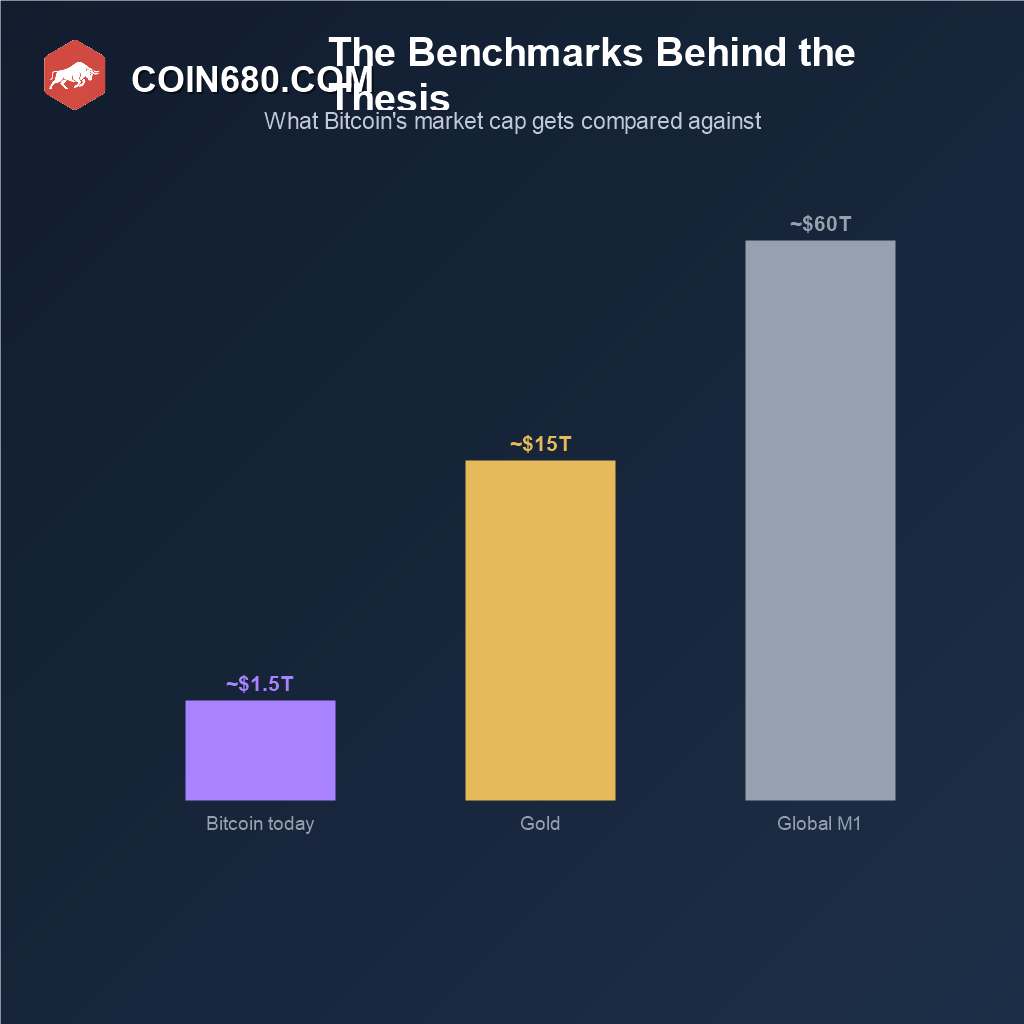
Global M1, the traditional definition of transaction money, totals roughly $60 trillion, and gold’s market capitalization has sat in the range of $15 trillion in recent estimates. If Bitcoin were to capture even a modest fraction of either pool, the implied per-coin valuation is dramatically higher than today’s price, which is exactly the mechanical logic driving TAM-based bull cases.
How Much of Its Addressable Market Bitcoin Has Actually Captured
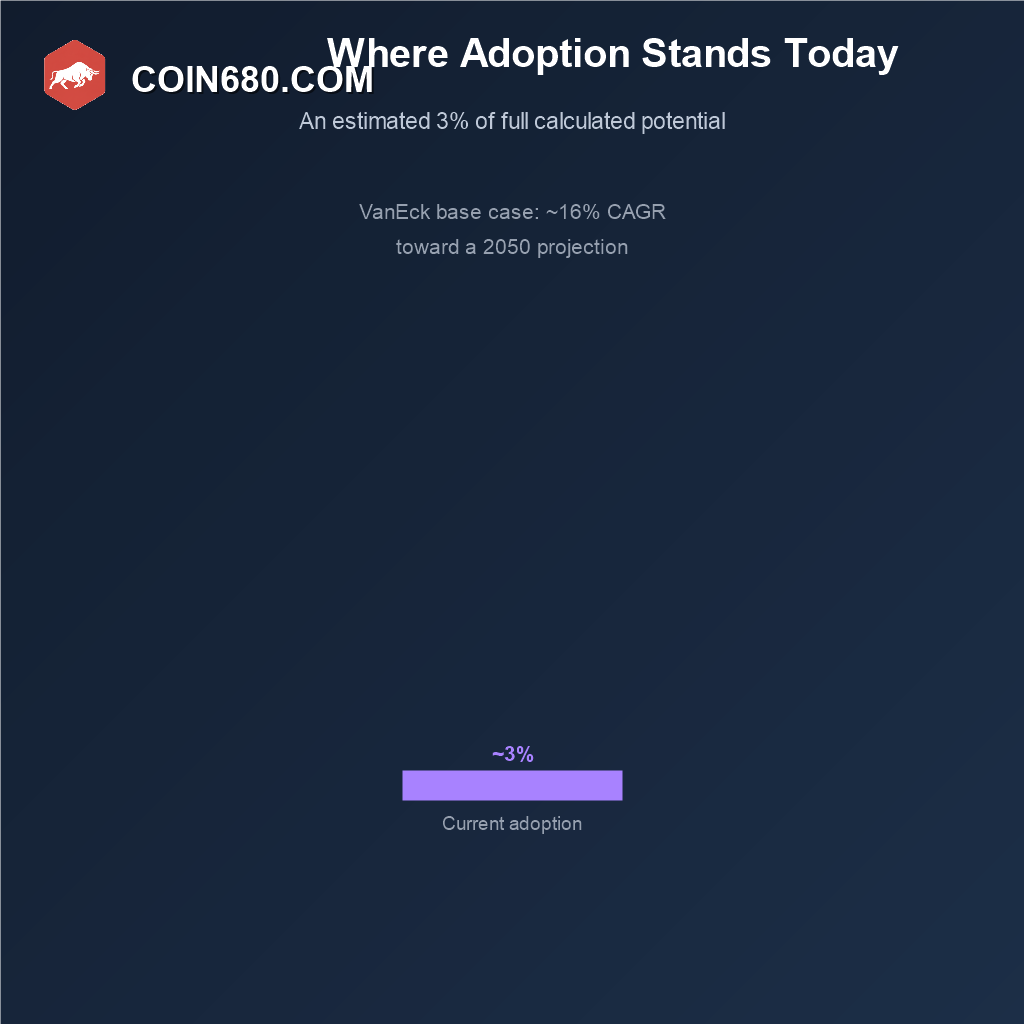
One widely cited estimate puts Bitcoin’s current adoption at roughly 3% of its full calculated potential, blending total addressable market size, institutional under-allocation, and global ownership rates into a single adoption figure. VanEck’s own long-term model projects a base-case compound annual growth rate around 16%, working out to a projected valuation near $2.9 million by 2050 if that trajectory holds.
Why This Framework Deserves Real Skepticism
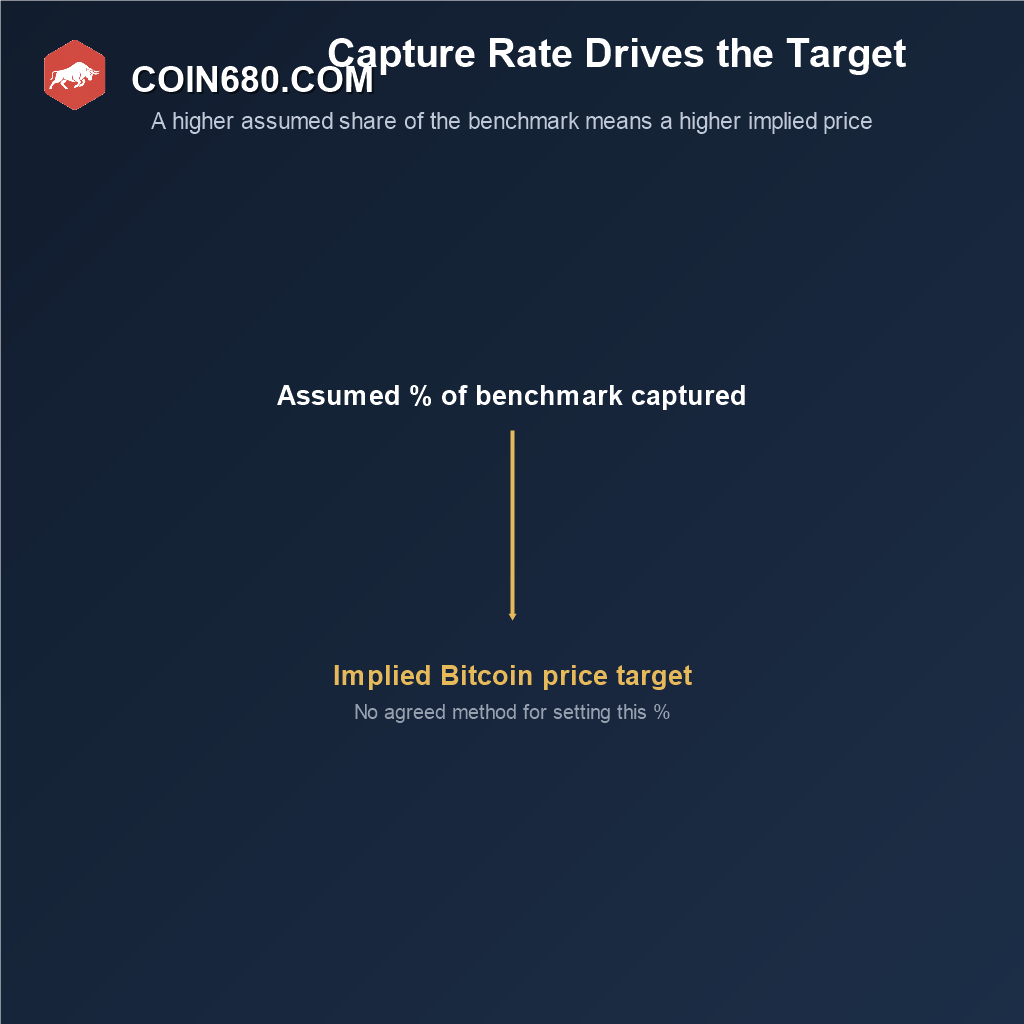
A TAM model is only as credible as its assumed capture rate, and there is no rigorous, agreed-upon method for predicting what percentage of gold’s market or global M1 Bitcoin will actually absorb, or by when. These figures function as illustrative upper bounds on a bull thesis, not as forecasts with any statistical confidence attached, and treating a $2.9 million or similar headline number as a base-case expectation rather than a best-case scenario is a common and costly misreading.
Frequently Asked Questions
What is the total addressable market thesis for Bitcoin?
It is a valuation framework that compares Bitcoin’s market cap to larger reference markets, commonly gold, global M1 money supply, or central bank reserves, to estimate what price Bitcoin could reach if it captured a given share of that larger pool.
How much of its addressable market has Bitcoin captured so far?
One commonly cited estimate places current adoption at roughly 3% of Bitcoin’s full calculated potential, though this figure depends heavily on which benchmarks and assumptions are used.
Are TAM-based price targets reliable predictions?
No, they are illustrative upper-bound scenarios based on assumed capture rates that have no rigorous, agreed-upon basis, not statistically grounded forecasts, and should be treated with real skepticism.
Which reference markets are most commonly used in TAM models?
Gold’s market capitalization, the global M1 money supply, and central bank reserve assets are the three benchmarks most frequently used to size Bitcoin’s addressable market.
This content is for educational purposes only and is not financial advice. Total addressable market projections are speculative and carry no guarantee of accuracy. Always research independently before investing.
This thesis connects to how institutions actually gain access to that potential upside. Continue with Bitcoin in a 401(k), revisit Bitcoin’s correlation during a crisis, or return to the full Bitcoin Academy.