
What Is the Relationship Between Rising National Debt and Bitcoin’s Narrative?
Every headline about a fresh record in the US national debt now seems to come with a follow-up line about what it means for Bitcoin. That pairing isn’t random, it reflects one of the more coherent macro arguments in Bitcoin’s entire investment case.
The Core Argument
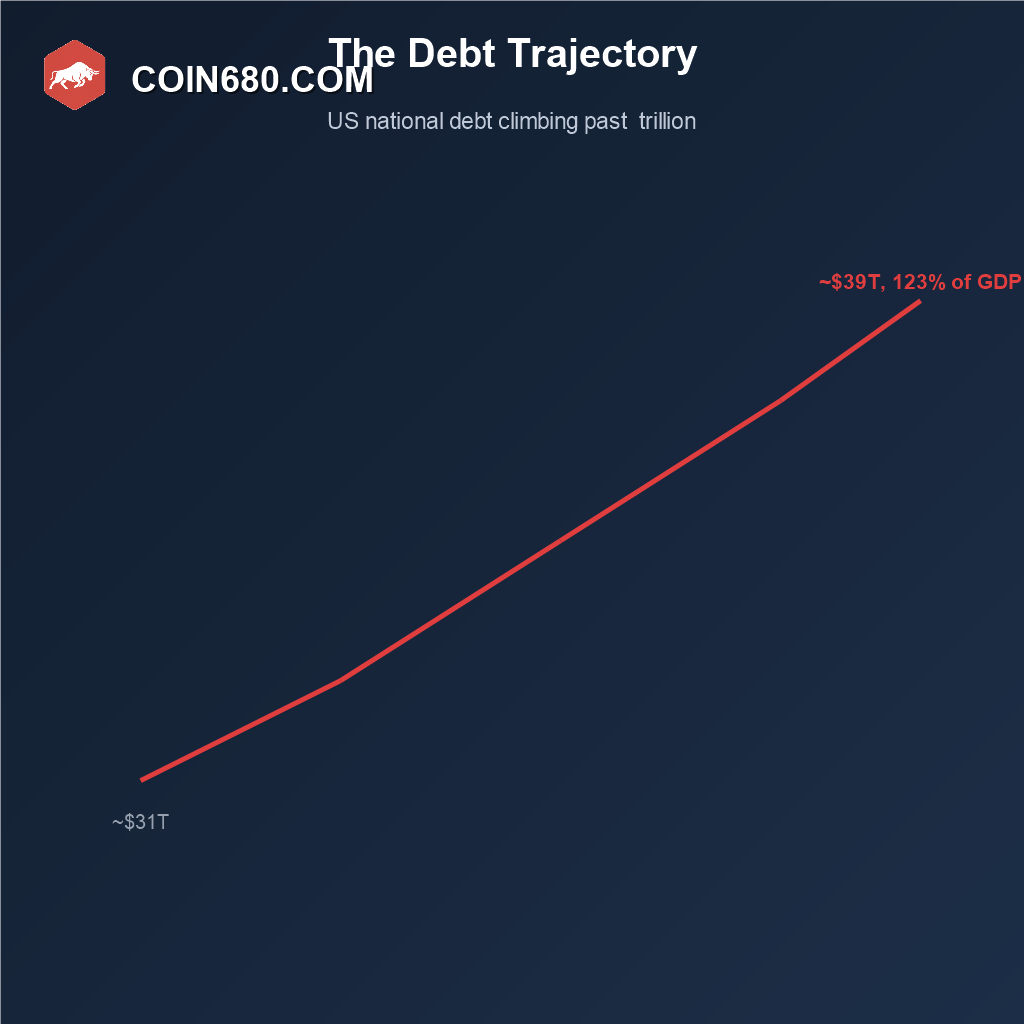
The reasoning is direct: the surest hedge against a government that can borrow without any hard limit is an asset that government cannot simply print more of. US gross national debt has climbed past $39 trillion, with a debt-to-GDP ratio around 123% and annual deficits nearing $2 trillion, a trajectory that strengthens the case, at least narratively, for holding something structurally outside any single government’s balance sheet.
The “Debasement Trade” Framing
Some institutional analysts, JPMorgan among them, have grouped Bitcoin and gold together under the label of the “debasement trade,” a shared bet against the long-term erosion of fiat currency value that unconstrained government borrowing implies. Under this framing, Bitcoin and gold aren’t really competing assets so much as two different expressions of the same underlying macro thesis.


Why This Is a Long Bet, Not a Short One
The debasement trade is explicitly a long-horizon position on currency and fiscal trajectory, and long-horizon macro bets can stay unprofitable for extended stretches before, if ever, actually resolving in the direction the thesis predicts. Rising debt figures making headlines today do not translate into an immediate, predictable Bitcoin price reaction, and treating the narrative as a short-term trading signal misreads what kind of argument it actually is.
What the Thesis Does Not Claim
This narrative is not a claim that national debt directly, mechanically drives Bitcoin’s price on any predictable timeline, nor that debt growth alone explains Bitcoin’s historical price action. It is a structural argument about why an asset outside any government’s control might appeal more over time as fiscal trajectories like the current one persist, a genuinely different claim than a short-term causal prediction.
Frequently Asked Questions
Does rising US national debt directly cause Bitcoin’s price to rise?
No, the relationship is a structural, long-horizon narrative rather than a direct or immediate causal mechanism. Debt headlines do not translate into predictable short-term price moves.
What is the “debasement trade”?
A framing used by some institutional analysts that groups Bitcoin and gold together as two different expressions of a shared bet against long-term currency debasement driven by unconstrained government borrowing.
How large is the current US national debt and debt-to-GDP ratio?
US gross national debt has surpassed $39 trillion, with a debt-to-GDP ratio around 123% and annual deficits approaching $2 trillion, based on recent figures.
Is the national debt narrative a reliable short-term trading signal for Bitcoin?
No, it is explicitly a long-horizon structural thesis, and long-horizon macro bets can remain unprofitable for extended periods before resolving, making it unsuitable as a short-term signal.
This content is for educational purposes only and is not financial advice. Macro narratives are not price predictions and carry no guarantee of playing out as described. Always research independently before investing.
This narrative connects directly to Bitcoin’s relationship with the monetary systems it’s positioned against. Continue with CBDCs vs Bitcoin, revisit why adoption is stronger in emerging markets, or return to the full Bitcoin Academy.