
What Are Central Bank Digital Currencies (CBDCs), and How Do They Differ From Bitcoin?
A government-issued digital dollar and Bitcoin can both be described as “digital money,” which is about where the similarity ends. A central bank digital currency and Bitcoin were built to solve almost opposite problems.
Who Actually Controls Each One
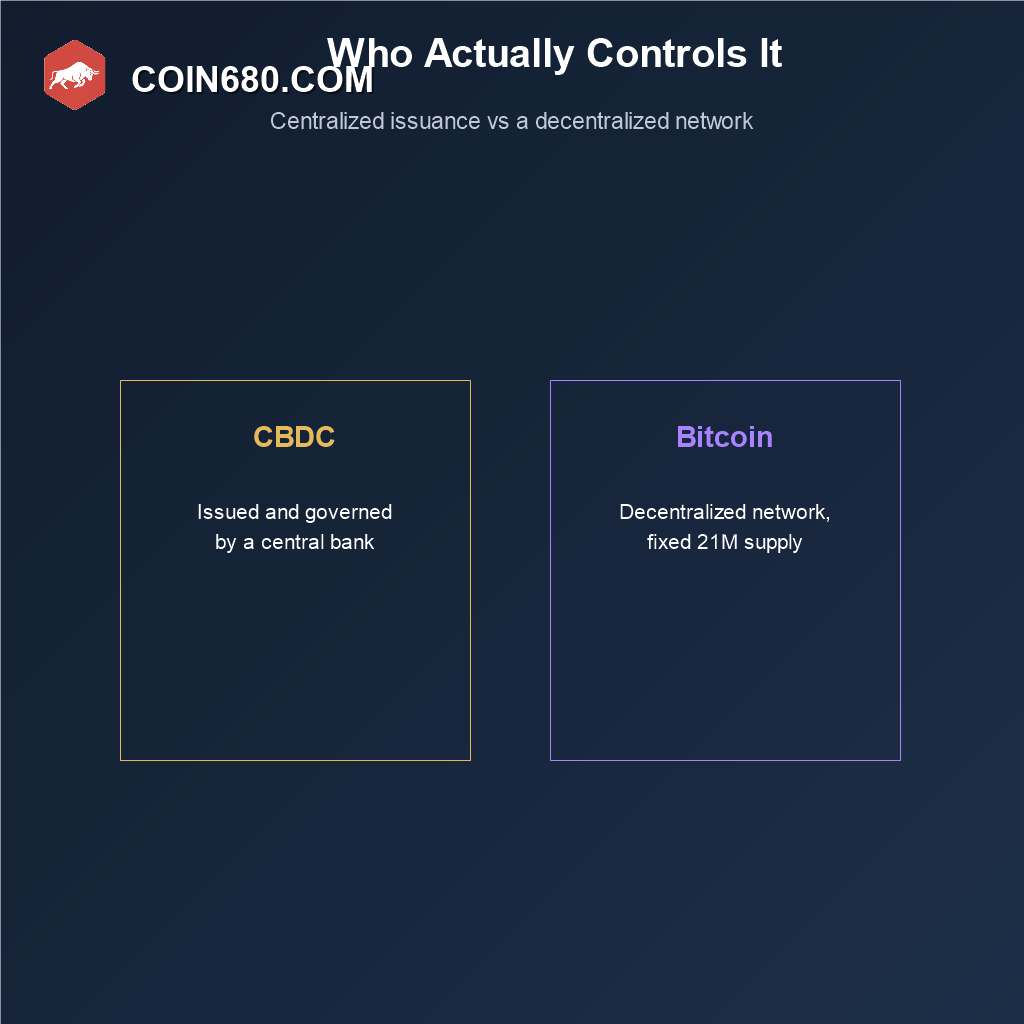
A CBDC is issued and governed directly by a central bank, a single, centralized authority with full discretion over its supply and rules. Bitcoin is governed by a decentralized network with no single controlling party and a fixed, code-enforced supply cap of 21 million coins, covered in detail earlier in this Academy. That control difference is the deepest and most consequential distinction between the two.
What Determines Their Value and Supply
A CBDC’s value and supply fluctuate according to the monetary policy decisions of its issuing central bank, the same basic mechanism that governs ordinary fiat currency today, just in digital form. Bitcoin’s supply follows a fixed, predetermined schedule that market forces alone determine the price of, with no committee able to vote to issue more.
Privacy and Government Visibility
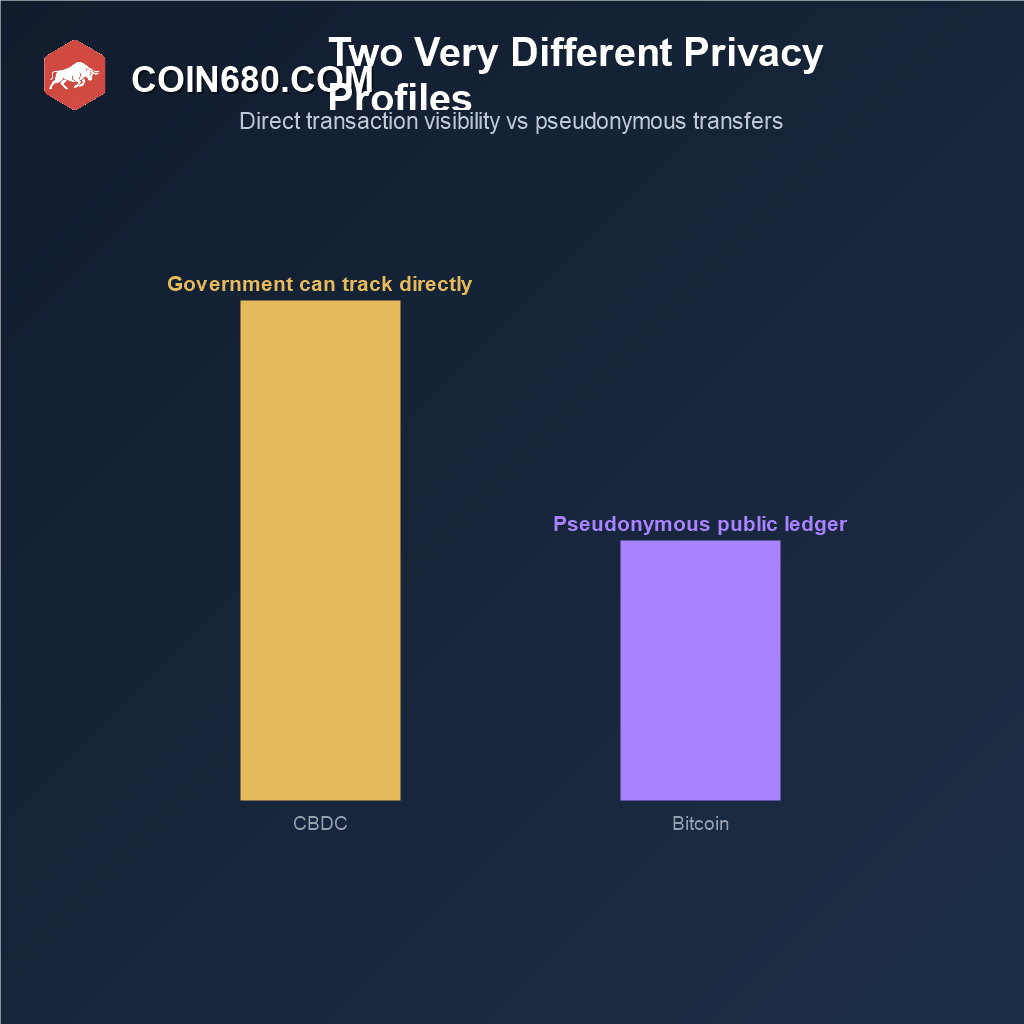
A CBDC could make it significantly easier for a government to directly track transactions in real time and, in principle, restrict what a specific unit of currency can be spent on, a level of visibility physical cash was never designed to allow. Bitcoin transactions are pseudonymous and recorded on a public ledger no single government controls, giving users a meaningfully different privacy profile, though still not full anonymity.
Why They Were Built for Different Purposes
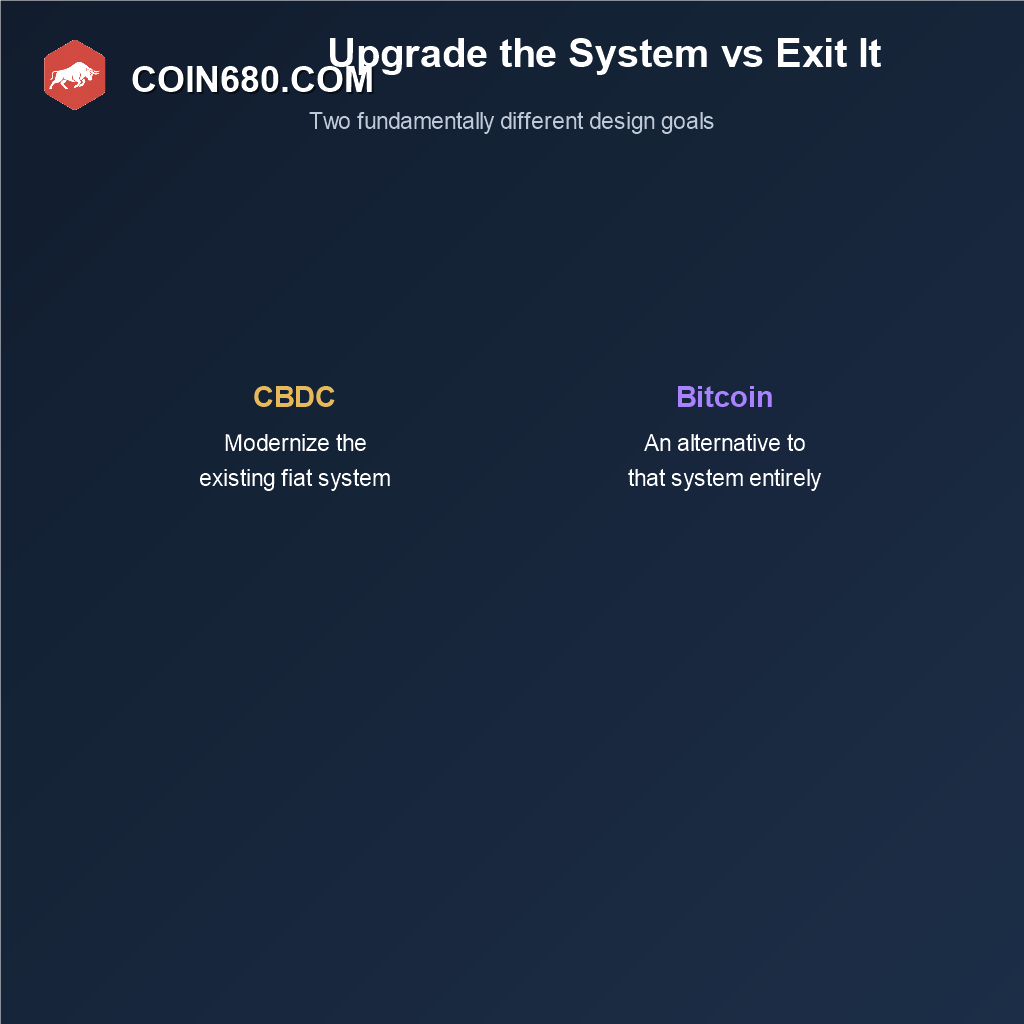
CBDCs are generally designed to modernize the existing fiat system: faster payments, better monetary policy transmission, and wider financial access within the current framework. Bitcoin was built as an alternative to that framework entirely, a hedge against inflation, centralized control, and the kind of currency debasement covered in this chapter’s national debt lesson. One upgrades the existing system, the other was designed as an exit from it.
Frequently Asked Questions
Is a CBDC the same thing as Bitcoin, just issued by a government?
No, they differ fundamentally in control, supply mechanics, and purpose. A CBDC is centrally issued and controlled with a flexible supply, while Bitcoin is decentralized with a fixed supply cap and no single controlling authority.
Which offers more financial privacy, a CBDC or Bitcoin?
Bitcoin’s pseudonymous, publicly verifiable ledger generally offers more privacy than a CBDC could, since a CBDC gives its issuing central bank direct visibility into transactions in a way traditional cash and Bitcoin do not.
Can a CBDC’s supply be changed after it launches?
Yes, a CBDC’s supply and value are subject to the ongoing monetary policy decisions of its issuing central bank, unlike Bitcoin’s fixed, code-enforced supply schedule.
Are CBDCs meant to replace Bitcoin?
Not directly, they serve different purposes. CBDCs aim to modernize the existing fiat monetary system, while Bitcoin was designed as an alternative outside that system entirely.
This content is for educational purposes only and is not financial advice. Regulatory and monetary developments around CBDCs continue to evolve. Always research independently before forming investment views.
Understanding CBDCs sets up the next lesson on monetary policy directly. Continue with quantitative easing and Bitcoin, revisit rising national debt and Bitcoin’s narrative, or return to the full Bitcoin Academy.