
Why Do Companies Hold Bitcoin on Their Balance Sheet?
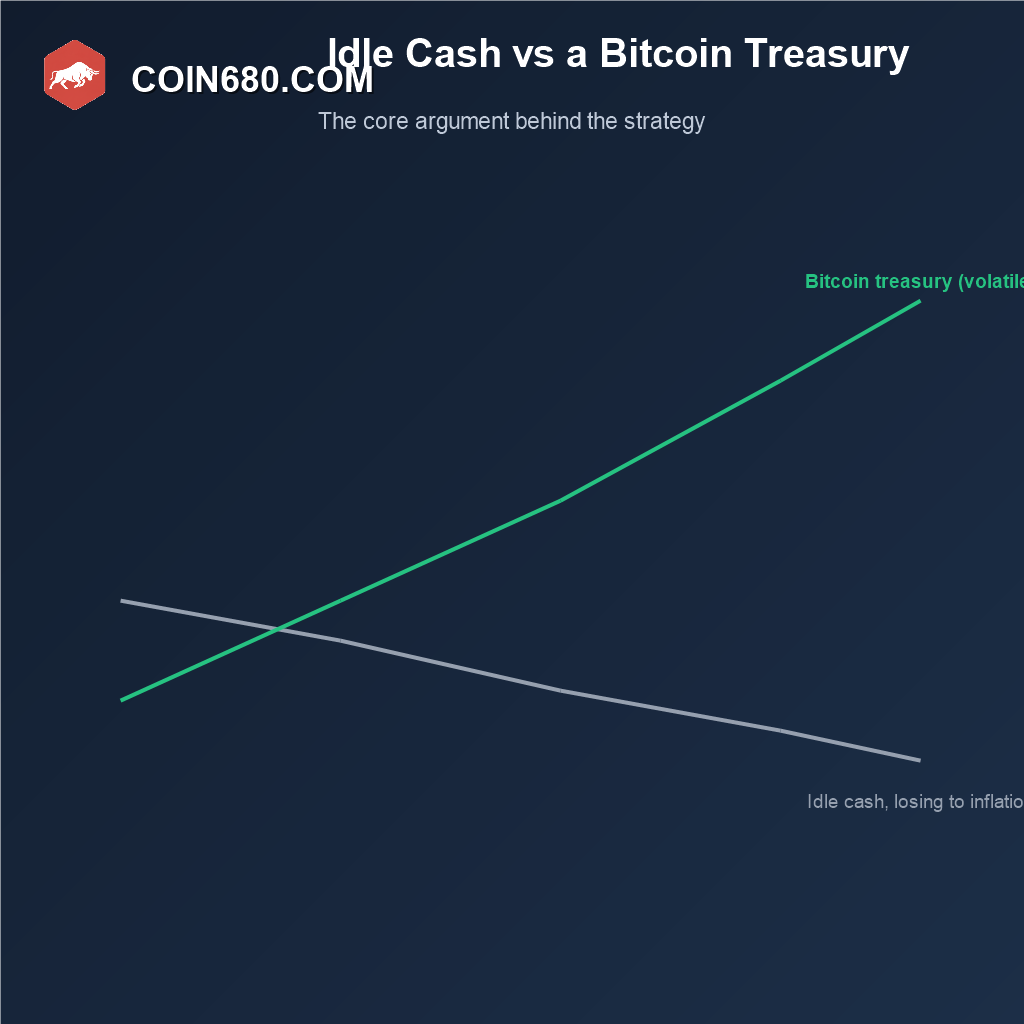
Holding a volatile digital asset on a corporate balance sheet, instead of cash or short-term bonds, sounds like an unusual decision for a finance department to make. The reasoning behind it, and the real risk it introduces, are both worth understanding before evaluating any specific company’s strategy.
The Case Companies Make for Holding Bitcoin
The argument mirrors the inflation-hedge and store-of-value theses covered earlier in this chapter, applied specifically to corporate cash management: idle cash sitting in low-yield accounts steadily loses purchasing power to inflation, and a fixed-supply asset offers a way to preserve treasury value over a longer horizon than a typical cash-management mandate. For some companies, it also doubles as a public statement of conviction, tying the company’s brand and stock story to bitcoin’s price performance.
The Real Risk It Introduces
Bitcoin’s volatility does not disappear once it sits on a balance sheet, and a company holding a large position can see its reported treasury value, and often its own stock price by extension, swing sharply with bitcoin’s price rather than staying stable like traditional cash reserves. That volatility can complicate accounting, financing terms, and investor expectations, particularly for a company whose core business has nothing to do with bitcoin in the first place.

How These Positions Actually Get Funded
Bitcoin treasury companies have used a mix of cash reserves, equity issuance, and convertible debt to fund large purchases, effectively using capital markets to lever up their bitcoin exposure. That financing structure amplifies both the upside and downside for shareholders far beyond what simply holding bitcoin directly would produce, since the company’s own debt and equity obligations layer additional risk on top of bitcoin’s price swings.

Frequently Asked Questions
Why would a company hold Bitcoin instead of cash?
The main argument mirrors the inflation-hedge and store-of-value theses covered earlier in this chapter, treating bitcoin as a way to preserve treasury purchasing power over a longer horizon than idle cash typically manages.
Does holding Bitcoin make a company’s stock more volatile?
Often yes, since the reported value of a large bitcoin treasury swings with bitcoin’s price, and that volatility frequently carries through to how investors value the company’s stock.
How do companies typically fund large Bitcoin purchases?
Common methods include existing cash reserves, issuing new equity, and raising convertible debt, all of which can amplify the position’s effect on shareholders beyond bitcoin’s price movement alone.
Is a corporate Bitcoin treasury strategy right for every company?
No, it introduces real volatility and financing complexity that may not suit every business model or shareholder base, which is why adoption has remained a deliberate choice for specific companies rather than a universal corporate practice.
Educational content only, this is not financial or investment advice. Corporate treasury strategies carry real financial risk and no outcome is guaranteed. Always research independently before investing.
Corporate treasuries are one of several institutional access points covered in this chapter. Continue with how spot Bitcoin ETFs work, the history of institutional adoption, or return to the full Bitcoin Academy.