
How Do Institutional Price Models Try to Value Bitcoin?
Unlike a company with earnings and cash flow, Bitcoin has no traditional financial statement to value it against. That gap hasn’t stopped institutions from building real, widely referenced models to try anyway, each starting from a genuinely different premise.
Stock-to-Flow: Scarcity as the Core Driver
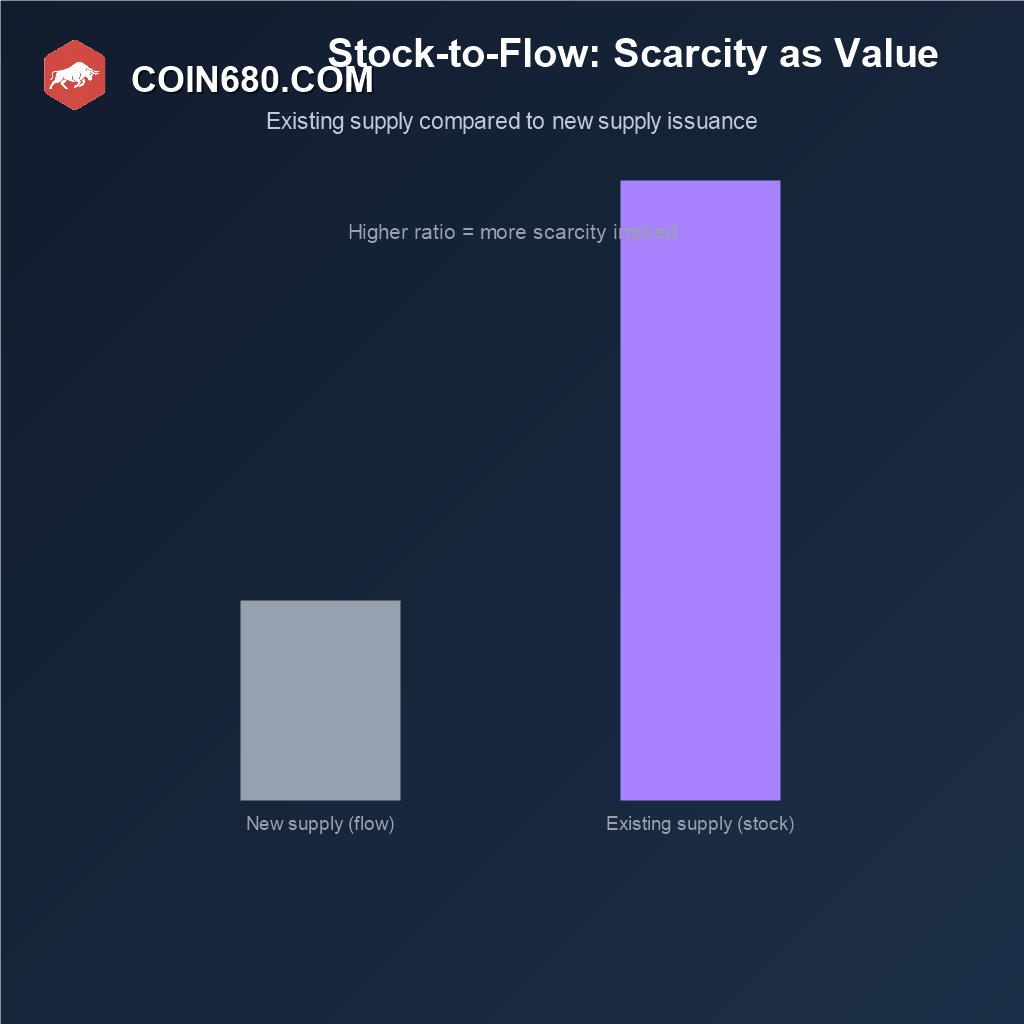
The stock-to-flow model values Bitcoin based on its scarcity, comparing existing supply against the rate of new supply entering circulation, with a higher ratio implying greater scarcity and, under the model’s logic, higher potential value. The model explains Bitcoin’s past returns reasonably well within the sample it was built on, but rigorous testing has found it has limited to no genuine predictive power out of sample, and its statistical significance largely disappears once time-based effects are properly controlled for.
Metcalfe’s Law: Value From the Network Itself
Metcalfe’s Law, long applied to telecom and technology networks, argues that a network’s value is proportional to the square of its number of connected users, capturing the idea that each additional user adds more total value than the last by creating more possible connections. Applied to Bitcoin, growing user and wallet counts are treated as a proxy for genuine network value growth, independent of price action alone.
Production Cost and the Mining Floor
The production cost model estimates a rough valuation floor based on what it actually costs miners, electricity, hardware, and operational overhead, to produce a single new bitcoin, on the logic that price rarely stays below the cost of production for long without pushing inefficient miners out of the network entirely. This model connects directly to the mining economics covered earlier in this Academy rather than treating Bitcoin as a purely financial asset.


Why Institutions Blend Multiple Models Rather Than Picking One
Combined analysis using stock-to-flow, Metcalfe’s Law, and regression techniques together has produced valuation ranges cited around $100,000 to $210,000 in various studies, while long-horizon models like VanEck’s project figures as high as $2.9 million by 2050 under specific growth assumptions. Every individual model carries real, documented weaknesses on its own, which is exactly why serious institutional research tends to treat them as a blended toolkit, cross-checking one model’s blind spots against another’s, rather than leaning on any single framework as a standalone answer.
Frequently Asked Questions
Is the stock-to-flow model considered a reliable Bitcoin price predictor?
Not particularly for forward prediction. It fits Bitcoin’s historical returns reasonably well within its original sample, but rigorous out-of-sample testing has found its predictive power limited to none once other statistical effects are controlled for.
What does Metcalfe’s Law actually measure when applied to Bitcoin?
It estimates network value as proportional to the square of the number of connected users, using growing wallet and user counts as a proxy for genuine network value growth independent of price alone.
How does the production cost model value Bitcoin?
It estimates a rough valuation floor based on the electricity, hardware, and operational cost required for miners to produce a new bitcoin, on the logic that price rarely stays below production cost for long.
Why don’t institutions just rely on one valuation model?
Each model has documented individual weaknesses, so blending multiple models together, cross-checking one against another’s blind spots, produces a more balanced view than treating any single framework as definitive.
This content is for educational purposes only and is not financial advice. Valuation models are analytical tools, not price guarantees, and carry significant uncertainty. Always research independently before investing.
This closes out the current run of Economics and Macro lessons. Revisit nominal vs real interest rates, where this chapter began, or explore the full Bitcoin Academy.