
What Is a Merkle Tree in Bitcoin?
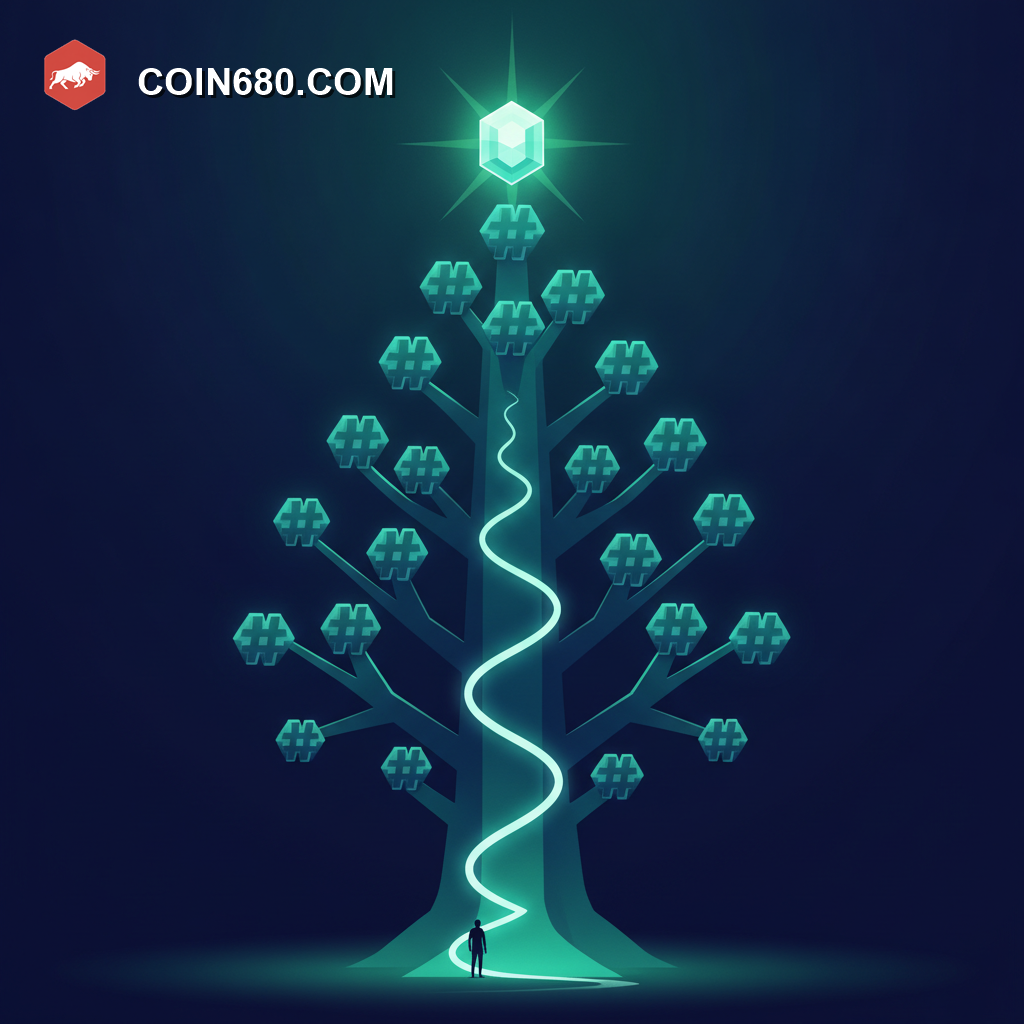
A single Bitcoin block can hold thousands of transactions, yet a node can prove any one of them is included using just a handful of short data points. The structure that makes that possible is called a Merkle tree.
A Merkle tree is a way of organizing data so that huge amounts of information can be summarized into a single short fingerprint, while still allowing anyone to prove that any individual piece of data is genuinely part of that set. In Bitcoin, every transaction in a block gets hashed, those hashes are paired up and hashed together, and this repeats layer by layer until a single value remains at the top: the Merkle root.
That Merkle root gets stored in the block header — the small piece of data that miners are actually doing Proof of Work against. This means the header stays a fixed, tiny size no matter whether the block contains ten transactions or ten thousand, since all of that transaction data has been compressed down into one value.
The practical payoff shows up in what’s called a Merkle proof. Suppose a lightweight wallet wants to verify that a specific transaction was really included in a specific block, without downloading every transaction in that block. It can request just the small chain of hashes connecting that one transaction up to the Merkle root, verify the math checks out, and confirm inclusion with a tiny amount of data.
This is the foundation of Simplified Payment Verification (SPV), the method many mobile and lightweight Bitcoin wallets use to check transactions without running a full node. It’s a meaningful tradeoff — SPV wallets trust that the block headers they’re checking against are honest, rather than independently verifying every rule the way a full node does.
Merkle trees aren’t unique to Bitcoin either — the same structure shows up in other distributed systems, anywhere a large dataset needs to be verified efficiently in pieces rather than all at once.
Want to understand how lightweight wallets differ from full nodes in more detail? Continue learning in the Bitcoin Academy.