
Market Orders vs Limit Orders: What’s the Difference?
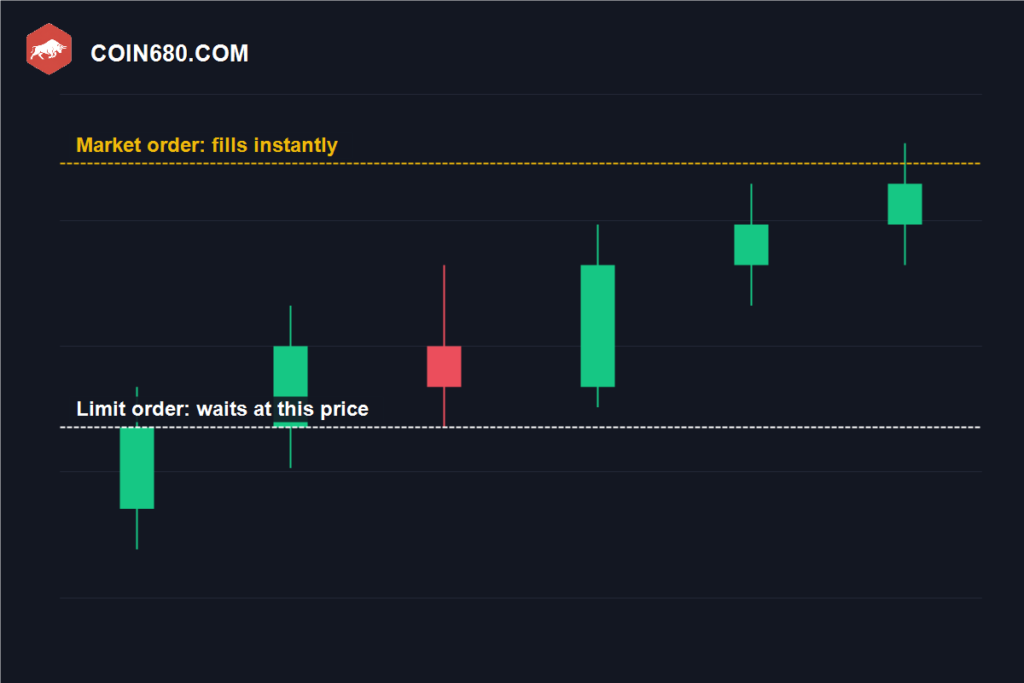
Two traders want to buy the exact same amount of Bitcoin. One gets it instantly at whatever price the market offers. The other waits, possibly for hours, for their own chosen price.
What’s the Difference Between a Market Order and a Limit Order?
A market order buys or sells immediately at the best currently available price in the order book, covered in more depth elsewhere in this Academy, prioritizing speed of execution over price control. A limit order instead specifies the exact price you’re willing to buy or sell at, and only executes if the market reaches that price, prioritizing price control over guaranteed speed.
When Does a Market Order Make Sense?
Market orders suit situations where executing immediately matters more than getting a specific price, such as a straightforward first-time purchase where you simply want Bitcoin now at a reasonable current price. The tradeoff is that in fast-moving or thin markets, the actual execution price can differ somewhat from the price you saw right before placing the order, a phenomenon called slippage, covered in more depth elsewhere in this Academy.
When Does a Limit Order Make Sense?
Limit orders suit situations where getting a specific price matters more than immediate execution, for example wanting to buy only if the price dips to a level you consider attractive. The tradeoff is that if the market never reaches your specified price, the order simply never fills, potentially leaving you without the position you wanted.
Market Orders vs Limit Orders Compared
| Factor | Market Order | Limit Order |
|---|---|---|
| Execution speed | Immediate | Only when price is reached, if ever |
| Price control | None, takes best available price | Full, executes only at your specified price or better |
| Risk of no execution | None | Yes, if price never reaches your level |
| Risk of slippage | Yes, in fast-moving markets | No, price is guaranteed if it fills |
Can You Combine Both Approaches?
Many traders use limit orders for planned purchases at specific target prices, while reserving market orders for situations requiring immediate execution, such as urgently needing to exit a position. Neither order type is universally better, the right choice depends entirely on what you’re actually trying to accomplish with a given trade.
Frequently Asked Questions
Do market orders and limit orders cost the same in fees?
Not always, some exchanges charge different fees for orders that add liquidity to the book, typically limit orders, versus orders that remove it, typically market orders, covered in more depth elsewhere in this Academy.
Can a limit order partially fill?
Yes, if only part of the size at your specified price is available, a limit order can fill partially, with the remainder staying open until fully filled or canceled.
Is a limit order guaranteed to execute at exactly my specified price?
It will execute at your specified price or better, but there’s no guarantee it executes at all if the market never reaches that level.
Want to understand how a stop-loss order can help protect a position automatically? Continue learning in the Bitcoin Academy.
Disclaimer: The content provided on this page is for informational and educational purposes only and does not constitute financial or investment advice. Cryptocurrency markets are highly volatile and involve significant risk of loss. Always do your own research and consult a licensed financial advisor before making any investment decisions.