
What Is the Crypto Fear and Greed Index?
Crypto markets run on emotion as much as fundamentals, and the Fear and Greed Index exists to put a single, easy-to-read number on that emotion, from the depths of panic all the way to euphoric excess.
What Is the Crypto Fear and Greed Index?
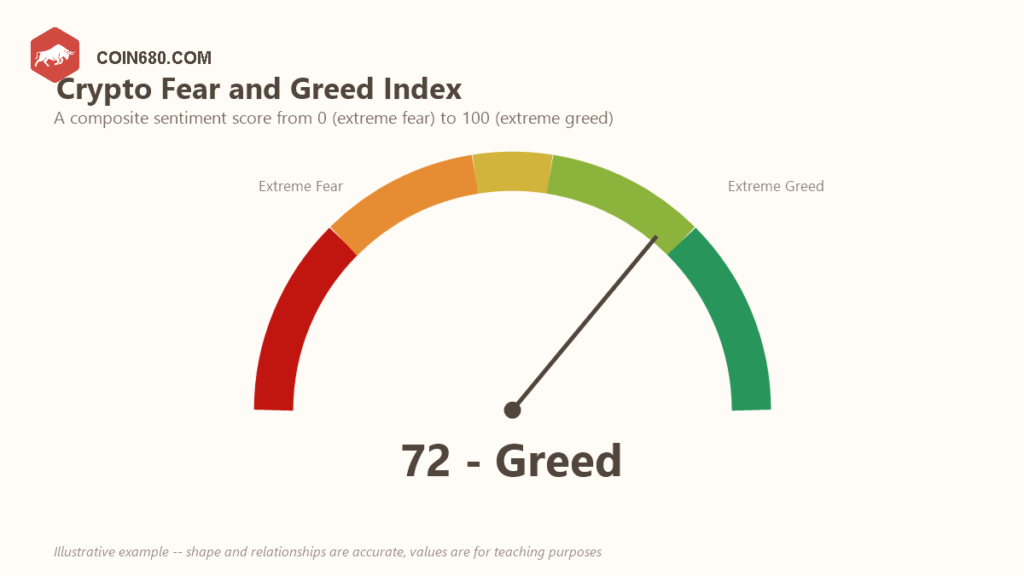
The Crypto Fear and Greed Index is a composite score, typically ranging from 0 to 100, that blends several inputs into a single sentiment reading. A score near 0 represents extreme fear, a score near 100 represents extreme greed, and the gauge above shows exactly this range, with a needle pointing toward the current reading across colored zones from red through to green.
What Goes Into the Score
- Volatility – comparing current price volatility and drawdowns against recent averages.
- Market momentum and volume – measuring whether trading volume and momentum are unusually high relative to recent history.
- Social media sentiment – analyzing the tone and volume of crypto-related posts and mentions.
- Dominance – tracking Bitcoin’s share of total crypto market capitalization, since rising dominance can reflect a flight to relative safety within crypto.
- Trends and search data – monitoring search interest as a rough proxy for retail attention and speculative interest.
How to Read the Score
Extreme fear readings, generally below 25, suggest investors are unusually worried, often following a sharp decline. Extreme greed readings, generally above 75, suggest investors are unusually confident, often following a strong rally. Scores in the middle range reflect a more balanced, less emotionally extreme market.
The Contrarian Reading
Many traders use the index as a contrarian signal, treating extreme fear as a potential opportunity zone and extreme greed as a potential caution zone, based on the idea that markets often overreact in both directions before eventually correcting back toward balance. This is a loose historical tendency, not a precise, mechanical rule, and extreme readings can persist for extended stretches without an immediate reversal.
What the Index Cannot Tell You
The index reflects the current emotional state of the market, not a prediction of exactly when that state will change. It also blends several different data sources with judgment calls about how to weight them, meaning different providers can and do produce somewhat different scores for the same underlying market conditions.
Frequently Asked Questions
How often does the Fear and Greed Index update?
Most versions of the index update daily, reflecting the latest available data across its component inputs.
Is a high greed reading always a warning sign?
Not automatically. Strong, healthy uptrends can sustain elevated greed readings for a while before any meaningful pullback occurs, so treat it as context rather than an automatic exit trigger.
Can the index be wrong?
It reflects a snapshot of current sentiment based on its chosen inputs, not an infallible signal, and different data sources or weighting choices can produce somewhat different readings.
Is there a Fear and Greed Index for traditional stock markets too?
Yes, a similar concept exists in traditional finance, built from a different set of inputs suited to equity markets, reflecting the same underlying idea of quantifying collective investor emotion.
This article is for educational purposes only and does not constitute financial advice. Sentiment indices do not guarantee future results. Always do your own research before making investment decisions.
Want to dig into the data behind the sentiment? Learn about market cap versus realized cap, explore the MVRV ratio, or continue learning in the Bitcoin Academy.